Produced by the LLLAB Board, Spring 2024
Argentinian sociologist Walter Mignolo reports, “‘Latin’ Americans have historically complained about and resented the US for appropriating the name ‘America’ to refer to itself as a country… ‘America’ taken as a referent to the US as a country subsumed other countries and realities into an imagined totality” (The Idea of Latin America, Malden: Blackwell, 2005, pp. 149, 151).
The legendary norteño musical group, Los Tigres del Norte, provides an example of this perspective in their song “América” (1986): “Si el que nace en Europa es Europeo / Y el que nace en el Africa, Africano / Yo he nacido en América y no veo / Porque yo no he de ser Americano / Porque América es todo el continente” (If someone born in Europe is European / and the one born in Africa is African / I was born in America and I don’t understand why I should not be American / Because America is the entire continent).
Chilean artist Alfredo Jaar, in “A Logo for America,” a 1987 public art installation in Times Square in New York City, reinstalled in 2014, likewise visually asserts that the term “America” refers to an entire hemisphere. Geaninne Gutiérrez Guimarães, curator of the Guggenheim Museum in Bilbao, comments: “‘A Logo for America’ asks the question, ‘What does it mean to be an American today?’ … With this iconic work, Jaar challenges the hegemonic ethnocentrism of the United States. It draws attention to the common but erroneous use of the term ‘America’ to refer to only one part of the American continent, a usage that excludes Central and South America.”
More recently, Puerto Rican rap artist Residente has released the track “This is Not America” (2022), whose lyrics critique the United States’ appropriation of the term “America”: “América no es sólo USA, papá / Esto es desde Tierra del Fuego hasta Canadá / Hay que ser bien bruto, bien hueco / Es como decir que África es solo Marruecos” (America is not just the USA, man / It’s from Tierra del Fuego to Canada / You’ve got to be really brutish, really hollow / It’s like saying that Africa is just Morocco). Residente comments on the arrogance and colonialist implications of this practice in a 2022 interview with Rolling Stone and a 2023 commentary of the lyrics with Genius.
Additionally, Karina Martinez-Carter, a US-based Mexican-American living in Argentina, reports on her observations of popular level linguistic usage of the term “America” in “What Does ‘American’ Actually Mean?” (The Atlantic, 19 June 2013).
The discussion about the meaning of “America” goes beyond the matter of its appropriation by the US, as the term itself is a colonial European superimposition (based on the Genovese explorer Amerigo Vespucci) onto the land mass of the Western hemisphere, known by many Indigenous groups as Turtle Island and Abya Yala (see Appendix A below), among other names. As Mignolo writes in The Idea of Latin America, “The idea of America, therefore, is a modern European invention and limited to Europeans’ view of the world and of their own history” (8). Mignolo predicts that the name “America” will become obsolete in coming decades (xv).
Appendix A: Commentary on terms ‘Abya Yala’ and ‘Latin America’
This commentary comes from the group Aprende +, published on their Facebook social media page on December 3, 2023 (link). The group’s page states, “Aprende + es una iniciativa educativa que se centra en la capacitación profesional desde una perspectiva sociocrítica” / Aprende + is an educational initiative centered on professional development from a sociocritical perspective (“Intro,” www.facebook.com/aprendemas.org, accessed January 4, 2025).
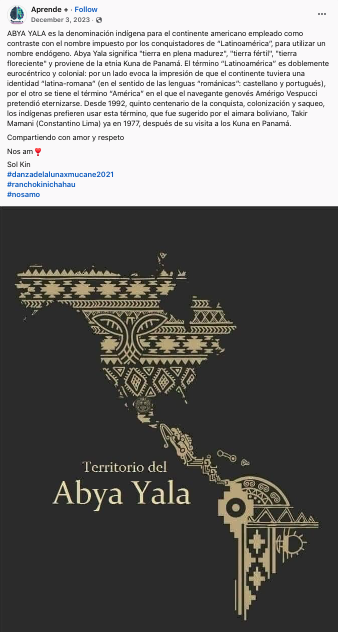
Image Description: A social media post from the group Aprende +, dated December 3, 2023. The post contains text accompanied by an artistic rendering of the western hemisphere with various Indigenous designs embedded into the figures of the continent, represented in brown and tan, with the title “Territorio del Abya Yala” (Territory of Abya Yala). The text reads,
“ABYA YALA es la denominación indígena para el continente americano empleado como contraste con el nombre impuesto por los conquistadores de ‘Latinoamérica’, para utilizar un nombre endógeno. Abya Yala significa ‘tierra en plena madurez’, ‘tierra fértil’, ‘tierra floreciente’ y proviene de la etnia Kuna de Panamá. El término ‘Latinoamérica’ es doblemente eurocéntrico y colonial: por un lado evoca la impresión de que el continente tuviera una identidad ‘latina-romana’ (en el sentido de las lenguas ‘románicas’: castellano y portugués), por el otro se tiene el término ‘América’ en el que el navegante genovés Amérigo Vespucci pretendió eternizarse. Desde 1992, quinto centenario de la conquista, colonización y saqueo, los indígenas prefieren usar esta [sic] término, que fue sugerido por el aimara boliviano, Takir Mamani (Constantino Lima) ya en 1977, después de su visita a los Kuna en Panamá.
Compartiendo con amor y respeto
Nos am* [La letra final se representa con un emoji de un corazón.]
Sol Kin
#danzadelalunaxmucane2021
#ranchokinichahau
#nosamo
English translation of Appendix A (translation generated by Facebook via its “see translation” option accompanying the original social media post):
“Abya Yala is the indigenous name for the American continent employed as a contrast to the name imposed by the conquerors of ‘Latin America’, to use an endogenous name. Abya Yala means ‘full ripening land’, ‘fertile land’, ‘flourishing land’ and it comes from the Kuna ethnicity of Panama. The term ‘Latin American’ is doubly Eurocentric and colonial: on the one hand it evokes the impression that the continent had a ‘Latin-Roman’ identity (in the sense of the ‘Romanic’ languages: Spanish and Portuguese), on the other there is the term ‘America’ in which [sic] the Genoese navigator Amérigo Vespucci sought to perpetuate. Since 1992, fifth centenary of the conquest, colonization and plunder, the indigenous people prefer to use this term, which was suggested by the Bolivian Aimara, Takir Mamani (Constantino Lima) already in 1977, after his visit to the Kuna in Panama.
Sharing with love and respect
We love [This phrase is followed by a heart emoji.]
Sol Kin
#danzadelalunaxmucane2021
#ranchokinichahau
#nosamo
 LLLAB
LLLAB 